Why women so naive dammit

When someone’s life is easy and full of fun, they continue to live the same way, despite having a meaningless life, conforming to what society wants rather than building themselves. In Henrick Ibson play, A Doll House, Nora is portrayed as a toy to Torvald, but when she sees Torvald’s true character, she realizes what her life has become and leaves. Her entire life has been nothing but playing and having fun, and when she learns Torvald’s reputation precedes his love for her, she decides to no longer conform to society and leaves her children and husband for a life that means something. Nora’s interactions with others show she is too naive and privileged to realize that her life is meaningless, and when she realizes, she goes over the top to change it. 

    Nora’s naive actions and desire to have fun cause her to be a bad mother and to be bossed around by her husband, forcing her to have the life she didn’t want without her noticing. One interaction that shows her naive nature is her interaction with her children. She plays with them like a child, yet does not raise them. Instead of taking responsibility and parenting them, she only plays with them, leaving the parenting to the Nurse. This way of parenting, despite it being normal for the time, is not ideal for a child’s growth. Nora’s interactions with Torvald also show her naive, playful nature, for she is treated like a toy, being called things like song-bird and squirrel. These nicknames are constant throughout the play, and within the names, Torvald sneaks in orders of things Nora shouldn’t do. She has a long history of being someone who spends way too much of other people’s money, never saving it, showing she only cares about having fun and not the future. Her naive nature is also shown by her dancing, for Torvald makes her his doll, playing with her and making her dance whenever he feels like it, and she consistently conforms to her husband’s wishes, making her into the doll that she doesn’t want to be. Her interactions with other characters not only show that she is naive, but also that she has always been extremely privileged. 

Nora’s privileged nature causes her to not care about her nurse and to keep secrets that ruin her relationship. Nora’s interaction with her nurse shows how privileged she is, for she sees the costume that she is to wear and wants to rip it to shreds immediately, while her nurse tries to comfort her. Also in this interaction, Nora disregards her nurse’s child, who she obviously misses and writes too, instead saying that Anne Marie was a good mother to her, showing that she does not care about the nurse’s daughter or that she misses her, but solely on herself. Finally, Nora uses her privileged nature to get out of taking care of the children. She already does not spend time with them unless she is playing, and she says she can’t see the kids anymore. The nurse makes it sound like the kids will forget about her, which is a terrible thing to think. Nora thinks that she is poisoning the kids with her actions, but since she is too privileged to even take care of them, this is never true. Along with her interactions with her nurse, her privilege is shown in any interaction about the incident that caused her to owe lots of money. Rather than telling her husband immediately, Nora is stuck up and tries to fix it herself, inevitably making it much worse when Torvald finds out. Had she not done this, her relationship would not have been ended like it did, however, not telling him caused her to find out Torvald’s true character. 

When Torvald’s true character is discovered, Nora goes over the top by leaving her husband and children simply to have a more meaningful life. Instead of leaving, she could have been less naive, and instead actually take care of her kids and be honest with her husband. Also, rather than being privileged about everything, she could have been less self absorbed, which would eliminate her desire to hide the loan from Torvald. This, however, doesn’t happen, and instead she ditches her kids and husband rather than facing her problems head on. This idea in the play can be related to by rich people in the modern world, for they are so loaded on money that they destroy their relationships with their desire to have fun and their extreme privilege. 
One man’s tragedy is another man’s comedy

William Shakespeare, world renowned playwright and poet, has shaped the culture of today with his works. Two of his important works, tragedies and comedies, have immense differences that are very clear. Tragedies include a tragic hero with a fatal flaw that inevitably kills the hero. They also include supernatural events, good and evil, and end with the hero dying. Comedies, on the other hand, are more light hearted and comedic. They include deception, typically with someone acting like they’re someone else, and a happy ending with a marriage at the end of the play. Despite their extreme differences, in some cases they can share thematic ideas that are important throughout the plays. The tragedy Othello and the comedy Twelfth Night share important thematic topics like revenge, lust, and manipulation.  

Revenge is a very important part of Othello, for it drives Iago to do terrible deeds to destroy the lives of Othello and Cassio. Iago is greatly angered by the promotion of Cassio to lieutenant over him, and believes that both Cassio and Othello are sleeping with his wife, so he makes an elaborate plan filled with manipulation and destruction to get back at them. Although it is a minor part, this sense of revenge is also present in Twelfth Night. After realizing that everyone was messing with him, Malvolio vows to get revenge on the entire group. This, however, is overshadowed by the future betrothal of Viola and Orsino, but it shows the tension that leads to revenge. After being tricked into trying to get with Olivia by Maria and the other servants, Malvolio is drawn to madness, for he is shown as a fool and a madman to the others after they used his greatest wish against him. This manipulation is an important part of both works, as it drives the plot of both plays. 

Manipulation is shown as one of the most important parts of Othello. Iago uses manipulation in his plan to trick weak people into performing actions that they wouldn’t normally do, making them seem stronger than they really are. He uses this manipulation on three weak characters: Roderigo, Cassio, and Othello. He uses Roderigo’s lack of decision making and desire for Desdemona to use him as a pawn in his plan. Likewise, he uses Cassio’s desire for reputation to get him into the perfect position to make Othello jealous. Finally, he uses Othello’s lack of Venetian knowledge and quick decision making to completely destroy Othello’s marriage and break Othello’s mind, causing him to kill his wife and himself. This manipulation on weak people to do things that they wouldn’t do is mirrored in Twelfth Night, for Maria, Fabian, Sir Toby, and Clown use Malvolio’s desire for Olivia and the house to trick him into acting very strange. His desire for Olivia is seen by the other servants of the house, and since he is so stuck up, they prank on him, writing a letter that appears to be in Olivia’s hand to get Malvolio to act different around Olivia. Malvolio, who would likely have not made a move on Olivia without this, is pushed to listen to the letter, thinking that his dream has come true, that he will be the master of the house. This manipulation drives him to gain a false sense of confidence, which leads him to follow the letter, only to be seen as mad and locked in the dark. This manipulation is only seen in one of the side plots of the story, but it helps with the comedy in the play. Malvolio’s desire for Olivia is not the only time that the ideas of love and lust are introduced in the plays, as they are important thematic topics in both plays. 

Love and lust drive Othello’s jealousy in Othello. Othello’s belief that Desdemona and Cassio have a lustful relationship causes him to collapse, deciding to kill her. This love is also important throughout their relationship, because even as he is about to kill her, Othello still loves her (either true love or lust), as he kisses her before she wakes, and admires her beauty. Also, Roderigo is drawn to Iago due to his desire for Desdemona, as he believed that he could win her from Othello with the help of Iago. This love and lust is incredibly important in Twelfth Night, for the main conflict in the play is due to the love triangle that is between the Duke, Olivia, and Viola/Cesario. This, along with the sibling love shown between Viola and Sebastian and homo-erotic love that Antonio has for Sebastian drive the play, providing comic relief.  Both plays have parallels in their thematic ideas, driving the plot of both plays, however, they both have major differences that separate them. Othello has a much darker view, with much longer scenes and more soliloquies, offering deeper ideas. It includes all of the aspects of the tragedies, with Othello being the tragic hero who kills himself after killing his wife, showing a very large difference between it and Twelfth Night. The comedy is much more light hearted, with short yet comical scenes. The ending is ironic yet happy, with a marriage that makes very little logical sense between both couples. Despite their differences, both plays represent the thematic ideas of revenge, manipulation, and love/lust.

Stealing God’s Thunder

For by grace you have been saved through faith. And this is not your own doing; it is the gift of God, not a result of works, so that no one may boast (Ephesians 2: 8-9). In these verses, it is shown that God saved man with faith. God did these deeds, not man, so one person shall not act as God and boast about having more power. Acting as God is heavily frowned upon in religion, as one of the Ten Commandments is to not idolize anything other than God. Despite these religious ideals, characters in literature are shown to break this code and play the role of God. In Mary Shelley’s Frankenstein, the main character Victor Frankenstien creates a living creature using science. After Dr. Frankenstein creates this beast, he is seemingly punished throughout the rest of the novel, as his family and friends are killed by the lonely monster. This view on religion, however, contrasts with that in John Irving’s A Prayer for Owen Meany, in which Owen Meany is seen as the second coming of Christ, and plays the role of God which he is portrayed as a hero. The conflicting perspectives of religion in the two works show vast differences in playing the role of God and how it can impact a person’s life. 

Religious ideas are all throughout Frankenstein despite it being a science fiction book. From the beginning of the novel, the professors see Victor as a disciple of science, alluding to the Bible and the disciples, who are the followers of Christ. Victor is seen to be a follower of science which leads him to disaster when he plays the role of God and creates a living organism out of dead matter. Other religious ideas are seen before Justine dies after being accused of killing William. She accepts the fact that she is going to die and says that she will see William in heaven. While doing this, Victor first realizes that he has done a huge mistake and that he is the murderer of William for creating the demon. Victor blames himself, and in doing so, keeps the monster to himself so that no one thinks him crazy. This secret throughout the novel gives Victor a sense of insecurity and loneliness, which is paralleled by the monsters loneliness. By playing the role of God, Victor seems to be punished. His family and close friends are all killed by the fiend, and after they are killed, Victor becomes so filled with revenge that he goes on a manhunt to kill the creature that he created. This view on playing the role of God is flipped in A Prayer for Owen Meany. 

The religious ideas in A Prayer for Owen Meany contrast greatly with those in Frankenstein. Owen Meany is portrayed as the second coming of Christ throughout the novel. Owen Meany sees himself as very powerful, and thinks that he is an instrument of God. He thinks that he has foresight in that he sees the angel of death before killing Teresa with the baseball and he says that he sees his own death in dreams. This foresight gives Owen Meany power, for he is an incredibly controlling man, as shown in the Christmas Pageant, town play, and news editorial, however, he is portrayed as a hero when he sacrifices himself to save the children, and is seen as a supernatural kid throughout the novel. Owen’s portrayal of God is seen as good, despite going against the basic laws of religion. 

While Victor Frankenstein shows the negatives of playing the role of God with his creature killing his family and his vengeful hunt for the creature, Owen Meany shows a more positive side of playing the role of God, for his sacrifice leads to him becoming a hero. Victor Frankenstein is punished for creating life, as Owen Meany is seen as a savior for using his foresight to sacrifice himself to save the children. Although Frankenstein’s role is directly creating life and Owen’s role is sacrificing himself and being able to see his death, both play an important role which they gain power by being like a God. The role of playing God gives the person power, but the power eventually will end the person’s life, whether it is a righteous ending that involves saving people or a vengeful death after chasing a man-made demon. Either way, taking on this role is frowned upon by religion, and although they lead to power, the power eventually ends the person’s life.

Women are responsible for all men’s downfall

Women bring out the worst side of people. Behind the fall of every great man is a woman. By conversing with a woman, one will be stripped of pride. By interacting with a woman, one will grow insecurity. By romanticizing with a woman, one will become jealous. In James Joyce’s “The Dead,” Gabriel interacts with three different women at a party and is overrun with these controlling emotions. Though women may not be the cause of these thematic topics in all cases, Gabriel’s character is revealed through his interactions with women, as he is shown as a prideful, insecure, jealous man who tries to fix his own problems before helping others. 

In the opening scene, Gabriel arrives at the party, and he interacts with Lily, the caretaker’s daughter who he has grown up since the last time he had seen her. Gabriel asks her about marrying, and rather than receiving an answer, Lily snaps at Gabriel, hurting his pride. I’m an attempt to fix his pride, Gabriel tips the young girl, and refuses to be told no, so rather than leaving with the girl snapping at him, he leaves with the girl calling back to him and thanking him for the generous tip. This shows that Gabriel is a prideful man, and that he will pay money to fix his pride. Gabriel is not only defined by his pride, but also his insecure nature. 

Later at the party, Gabriel dances with an old comrade from college, Miss Ivors. As they danced, Miss Ivors pokes fun at Gabriel, calling him a West Briton, which is someone who does not support the movement for Irish independence. This deeply offends Gabriel, as he tries to defend himself, but is unable to say the right words to do so. He continues to think about what she said and if people really think that he is a West Briton, heavily defending himself even though it was simply a joke. This shows his insecure nature, for rather than just taking the joke, he defends himself heavily and is choked up on the words in trying to do so. Gabriel, however, is blinded by his insecurity, for he fails to realize that in defending himself, he hurts Miss Ivors feelings, for she leaves the party very early. As the novel moves on, Gabriel’s pride and insecurities are both seen as his jealous nature comes out. 

After the party, Gabriel and his wife go to a hotel, and upon arriving, Gabriel is filled with lust and wishes to overpower his wife. This wish to do so, however, is overshadowed by what Gretta is thinking about, for her silence shows something is on her mind. When Gabriel asks her, she responds that she is thinking about someone, and Gabriel is immediately filled with jealousy. As Gretta tells the story of the person who she was thinking about, a man who had loved her and had risked his life for her, and inevitably died for her, Gabriel is filled with jealousy. His pride is severely hurt for he believes that all this time he was being compared to some guy, and that she was always thinking about him. His pride and jealous rage once again overshadows what the woman is doing, for Gretta begins to cry without end. Gabriel comforts her for a little bit by simply caressing her hand, but stops and leaves her rather than really comforting her. This shows how his jealousy and prideful manner comes before anyone else’s problems, for he is angered after this just because his lustful feelings were not fulfilled and because she was thinking of someone who died for her many years before. When she is asleep, he looks at her and ponders their marriage and the man who risked his life for her, and in doing so, shows the disconnect that his jealousy has caused with his wife, for he looks at her as if they are not married, and says that she is not the same face that the man would have saved, calling her aged and not as beautiful rather than worrying about her personality. This shows that he is once again attempting to fix his pride to feel better about himself. 

Throughout the short novel, Gabriel is shown as a prideful, insecure, and jealous man who will do whatever it takes to repair his pride, and in turn, ends up hurting other people’s feelings. Through his interactions with women, his negative qualities come out, showing the pride, insecurity, and jealousy that is in his true nature. 

The Power of Storytelling

Stories have the power to transform events that would typically destroy a person into something that is manageable. Tim O’Brien’s The Things They Carried is an episodic novel that shows the power that storytelling has on the mind. The novel shows many stories about the Vietnam War, mainly focusing on one group of soldiers in the bush. With the power of storytelling, O’Brien illustrates Vietnam as a place where brotherhood is formed, and the soldiers use these stories to distract from the terrible outcomes of war. 

The Vietnam War split the United States in two, the government and the people who supported the government’s goal in eliminating communism and the people who were against the war. Despite this split in the war, O’Brien shows that it also brought people together. The soldiers in the war became so close that they “share the same blood.” This connection between the soldiers shows the brotherhood created through the terrible realities of death and fear in the war. The soldiers not only share the blood, but they also share the stories that help them forget about these terrible realities. When telling the stories, they make death seem like it is not so bad. When Ted Lavender died, the soldiers talked to him as if he were still alive and mimicked what he would have said in death. This storytelling helps the soldiers to cope with the loss of their comrade, and transitions into people making jokes about the people who are killed in action, like Kiowa drowning in shit. Storytelling helps people focus on things other than the war, which leads to optimism. This isn’t limited to making optimism in the war, but it also helps shift the blame of someone dying away from people. This is shown by the death of Kiowa. O’Brien uses a story of Norman Bowker’s life after the war to show his regret of not saving Kiowa. After describing a meaningless life that ends with Bowker hanging himself, O’Brien states that Norman is not responsible for the death of Kiowa, but that he, O’Brien, was responsible for Kiowa’s death. This use of storytelling to shift blame helps the soldiers deal with the war and the PTSD that comes after the war. 

Storytelling can change the way events are viewed and can bring optimism to even the darkest of places. It can impact a person no matter what situation they are in. By telling stories, people can be brought together while being distracted from events that would be tough to deal with and shifting blame away from themselves.

Summer Obsessions

Obsession. Lust. Neil Klugman is a lower to middle class Jewish college graduate working at a library. One day while he is at the country club, he holds a girls glasses, and instantly falls in love, almost immediately finding out who she is and calling her. She is a part of the upper class, with a different yet parallel lifestyle compared to Neil. Their relationship quickly falls into a lustful summer fling, which ends the first time Neil visits her in college. Neil wastes his time obsessively fantasizing over a summer fling, and in doing so, he separates himself from everyone he cares about. 

In the beginning of this summer fling, it was obvious that Neil was obsessive. He found out who she was without knowing her name, and immediately found out what she was doing and wanted to see her. They meet at the tennis courts, and upon their second time meeting each other, they kiss, showing how there is no substance in the relationship. They don’t even share personal information until their second meeting, and they only do this in between flings to keep it “fun.” As the relationship moves forward, the lustful actions become more apparent, and Neil’s obsession becomes more prominent. While on vacation, they begin running, and Neil goes to having fun to obsessively trying to beat Brenda, until the point that she falls over. This same type of obsessive behavior continues as he is playing ping pong with Brenda’s little sister. He destroys her in the game until the point that she starts crying. This continuation of obsessive behavior does not stop here, but goes to the point that he pushes Brenda to get a diaphragm despite her obvious arguing against it. He does not have any solid reason to get one besides he wants her to have it, and in the long run, it only hurts the relationship. This obsessive behavior and argument should have been a red flag that the relationship was going to end, but Neil, through all of this, thinks he wants to marry Brenda, even despite at one point her saying she only let him stay on vacation for another week so they could be done. After vacation, Neil continues to obsessively think about her, and writes to her as soon as she leaves. On his first visit to her, however, he realizes that Brenda’s mom found the diaphragm , and what once was a fun summer fling quickly ends with Neil leaving her. Ironically, Neil was going to say something about marriage, attesting to his obsessive behavior. In obsessing over the girl he obviously had no future with, Neil upsets his Aunt multiple times with his absence, upsetting her and making her worried sick while he is on vacation with her and making her upset that he is missing the holiday and his parents. Neil should have ended the lustful fling when it started, for it led to him obsessing over a girl he had no chance with, causing him to upset his family.

Religion? Never heard of her.

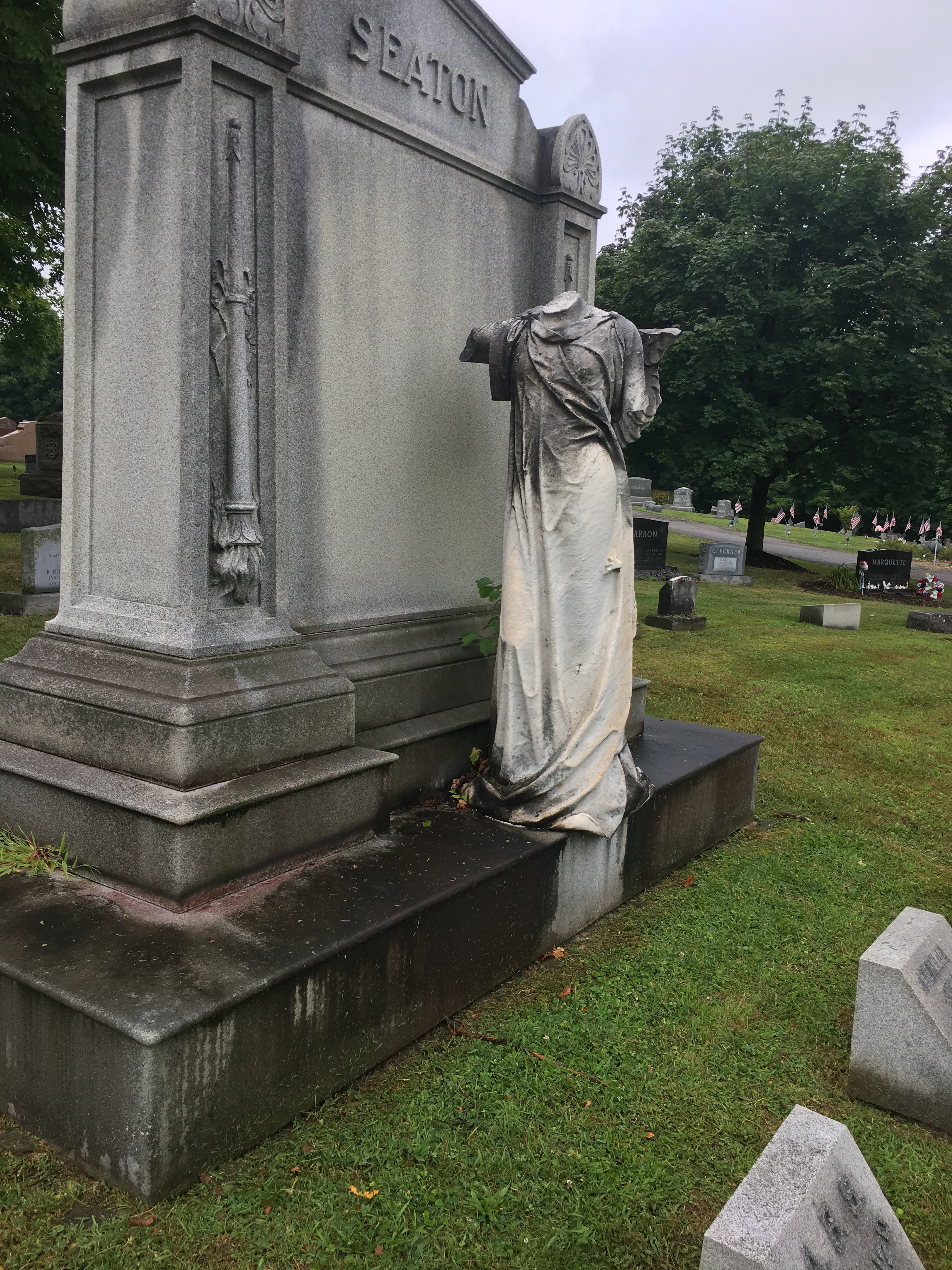
I noticed this statue at work after reading the section in the book about it. This doesn’t have to do with my blog post, just something kool👍

All my life, religion has been something that has not affected my life at all whatsoever. I grew up in a family that really had no religious beliefs, so my whole life I followed suit. At times, people would get me to go to church, but every time I was always filled with disbelief and felt out of place. In general, I don’t believe in a god, but I could be wrong, I really don’t care, for I am focused on living my best life right now. If there is some sort of afterlife or god, then I hope my actions will have been good enough to take me to the right place, and if not, so be it. Due to my beliefs, or lack thereof, when the book opened up by saying that this story made the narrator believe in religion, I was slightly interested, but in the end chose to doubt that the book would have that effect on me. In the end, I was right, the book didn’t just confirm my non belief, but it also made my disliking of religion grow.

One thing that made my dislike for religion grow was the mentioning of corruption in the government with religion. This is one of the only things in the book that I agree with. People in power are shown to be part of the religion out in the open to gain support, for example JFK, yet behind closed doors, they don’t even worry about it and do things just for the pleasure. Lots of people see it as it’s there way or the highway, as shown by Owen’s future rant and by the Rev. Mr. Wiggins not showing up to the funeral just because he couldn’t have it at his church. As I see it, all that religion does is push people apart, without it everything would be more unified.

Another thing in the book that made my dislike for religion stronger was the fact that all the miracles happening at the end seemed like they were just really weird supernatural things, like a ghost haunting Johnny, or even just figments of Johnny’s imagination. When he was told that there was nothing to fear in the secret room with the jellies, it would have been totally believable that Johnny was just hearing things from the past, and Owen said those exact words to Johnny before he died. On the subject of his falling, he was really drunk, so there was a chance that he didn’t even really fall, he just swayed drunkenly. When Owen took control of Rev. Merrill, it seemed more ghostlike than angelic, as I imagined a scene like that in a horror movie when I read that section.

The final reason that this novel has strengthened my disliking for religion was due to the hypocrisy. The character that was supposedly the second coming of Jesus was a disrespectful brat to his parents, most likely participated in the premarital love making, participated in a petty “war” with the headmaster that lead to heavy vandalism, and was a total control freak when it came to basically anything. I understand that he is supposed to be a modern day Christ figure, but he seems more like a child to me, and there is no way that he could have been born in the manner that his father claims. Also, the Rev. Merrill’s actions are not those that you would see from a truly righteous pastor. The man had a fling with another woman despite being married, and had a son from it, yet continued to preach the total opposite moral to the people. Also, it seems ridiculous to me that a pastor can stop believing in god, yet continue to teach about him. Finally, the way that Johnny got him to believe again by tricking him was simply terrible. If a trick is all it takes for someone to believe, how do we know that everything in the novel wasn’t a trick, like the dream or the angel of death, or any other coincidences throughout the novel?

Though this novel made me dislike religion more, it made me understand it better, helping me understand why people practice these religions that I know nothing about.

Owen Meany’s Control

At the beginning of the novel, Owen Meany seems to be selfish and slightly controlling. After Johnny’s mothers death, Owen takes the claws from the Armadillo and takes the dress dummy for himself while they are mourning, slightly taking control of the way that they mourn their loss. He pushes religious messages onto Johnny, saying he is God’s instrument by taking the class of the armadillo, and he insists that it is better for Dan that he doesn’t see the dress dummy that looks a lot like his past wife. Owen slightly takes control of this situation, but as the story progresses, he is seen taking more and more control of every situation, while slowly seeming to deteriorate.

Owen starts gaining more control in the Christmas pageant where he gains the role of the Christ child. However, as he gains control, he seems to deteriorate more and more. Owen completely takes over the pageant, changing everything and angering Barb Wiggins, who was used to having the pageant go her way. On the day of the pageant, Barb Wiggins tries to mess with Owen Meany, but he handles the “technical difficulty” well, and further takes control of the pageant by feeding the lines to the angel who couldn’t remember his part. The pageant seems to be going well other than these mishaps, until Owen has a completely unexpected and unnecessary outburst about his parents being in the audience. This made him seem completely disrespectful, for he went off on his own parents just because they were supporting him at the church. His next power trip was when he gained the role of the Ghost of Christmas Future, and basically took over the entire play. His deterioration was shown more when he had a vision of his own grave, with the date that he will die. As someone who does not believe in visions or miracles, I see this as Owen going crazy and completely coincidental that Lydia died during the play. This vision causes Owen to deteriorate even more, since after this, Owen gets even more powerful during his time at Gravesend Academy, begins chain smoking, and gains a bad man reputation at the boardwalk. At the academy, Owen becomes known as the Voice, and becomes more powerful than he ever was before, having basically the entire school behind him. Not only do the students admire him, but the faculty respect him as a higher figure, granting him access to private meetings with possible headmaster candidates. This push for power and list of poor health choices he makes could show that his death is coming soon, so he is almost care free and wants power before he dies. Before Owen dies, I believe that he will continue to hunt for power and he will continue to deteriorate. Also, due to his parallelism to a Christ figure, I believe he will die a martyr in some sort of dramatic fashion. Furthermore, I think that the election of JFK at the end of the chapter will have something to do with Owen’s early death, since Johnny is shown to hate the American government as an adult.

The Armadillo

Dan Needham, a teacher at the Gravesend Academy, often uses props while talking to help the listeners focus or to distract them from what they would later find out. When he first goes to meet the Wheelwrights, he brings a prop for Johnny, a bag with another bag in it, and tells him to not look inside and to keep his eye on it, distracting the young boy. When Johnny eventually gets curious, he finds a stuffed armadillo inside. Though he is afraid of it at first glance, he and his best friend becomes very fond of the stuffed toy and keeps it by his nightstand. Not only is the stuffed armadillo a prop for Johnny when Dan first meets the family, but it is also a parallel for Owen Meany and the dummy and a symbol of love and trust.

The Armadillo and Owen Meany have a lot of parallels. Both are very endangered creatures. Owen being an incredibly small man with a voice that sounds terribly high pitch, simply a one of a kind person, while the armadillo is a one of a kind creature to Johnny. Also, both are not appealing to the eye, but people still end up loving them. Owen is a disgusting looking person, with huge ears and a very small body, but people still seem to be drawn to him like a beacon and are unable to stop themselves from touching him. In the same way, the armadillo is a very weird creature, looking like a rat-like anteater with a shell, but Johnny and Owen fall in love with the creature and constantly play with it. Finally, the stuffed animal represents a christ figure, like Owen. The animal is completely respected by the boys, and they depended on it to help them get through not only the fun times, but also the hard times, like when Johnny’s mother dies. Also, after Owen declaws the creature, he makes it seem like he is God’s instrument, and shows that by declawing the creature, adding to the motif of amputation. This motif is shared with the dummy that Johnny’s mother uses to make new clothes. Both objects are loved by their owners, and both represent important characters in the book. The armadillo isn’t only doubled with other things throughout the novel, but is also used as a symbol for love and truth.

The armadillo is also used to symbolize love and truth. The armadillo is given to Johnny when they first met, and begins to show the love between the two as time goes on and they grow closer. It also symbolizes the trust that Johnny has for Owen, for he trusts Owen enough to play with and even keep the stuffed toy that means so much to him. Finally, both of the boys love the toy and constantly are protecting it from people like Johnny’s cousins. As the novel continues, I believe that the armadillo will continue to be an important symbol and double to Owen.

Design a site like this with WordPress.com
Get started